Operations
How to Write to Parents About a Behaviour Concern (With Templates)
Every school sends notes home about behaviour, and most of them are written in a hurry, at the end of a long day, by a teacher who is still annoyed. The result is a letter that reads as an accusation, a parent who arrives defensive, and a meeting spent arguing about the letter instead of the child. It does not have to go that way. A good behaviour letter is short, specific and calm, and it asks the parent to help rather than to agree that their child is a problem. This article sets out what to put in one and what to leave out, then gives you two templates to copy.
What the letter is for
A behaviour letter has one job: to give the parent an accurate account of what happened and a clear idea of what the school would like them to do next. It is not the school's record of the incident, and it is not the place to set out everything the child has done this term.
Keeping those apart is the most useful habit a school can build. The staff record can be blunt and complete. The letter to parents should be accurate, fair and written for a family to read at their kitchen table.
What to include
- What happened, in one or two plain sentences, with the day and the place
- What the school has already done about it
- What you would like the parent to do, if anything: talk to their child, come in, sign and return
- A date, if you are asking them to come in or reply
- A name and a way to reach the person who wrote it
- Something true and positive, if there is something. A child who owned up deserves to have that said
What to leave out
- Other children's names. The parent of every child involved gets their own letter about their own child
- Labels such as rude, lazy or a troublemaker. Describe what the child did, not what the child is
- Opinions about the family or the home
- A list of past incidents, unless the parent has already been told about each one
- Anything you would not be comfortable reading aloud to the parent in person
Template: a concern
Dear Parent,
Today, [day and date], during [break / the lesson / assembly], [Child's name] [what happened, in one plain sentence]. [What the school did, for example: We spoke to [Child's name] about it straight away, and they apologised.]
We would be grateful if you could talk to [Child's name] about this at home. [If needed: We would also like to meet you to discuss how we can support [Child's name]. Please let us know a time that suits you before [date].]
[Optional: [Child's name] was honest about what happened, which we appreciate.]
If you have any questions, please contact [name, role] at [number or email].
Yours sincerely,
[Name], [Role]
Template: appreciation
Dear Parent,
We wanted to let you know that today [Child's name] [what they did, specifically: looked after a new classmate all week / gave an excellent presentation in assembly / handed in a lost wallet].
It was noticed and appreciated by [teacher / the whole class], and we thought you would like to hear it from us.
With best wishes,
[Name], [Role]
Schools that only write home when something has gone wrong teach parents to dread a note from school. A short appreciation letter now and then changes how the next concern is read.
Sending it, and knowing it arrived
A letter in a school bag may or may not reach home. A message in a class WhatsApp group reaches every family except the one it was about, which is worse. Whatever channel you use, send it to that family alone, and keep a copy of what they were told alongside your own record of what happened.
Ask the parent to acknowledge it. A signed slip, a reply or a tap in an app all tell you the same thing: the parent has read it, and the next conversation can start from there.
Where Edflo fits
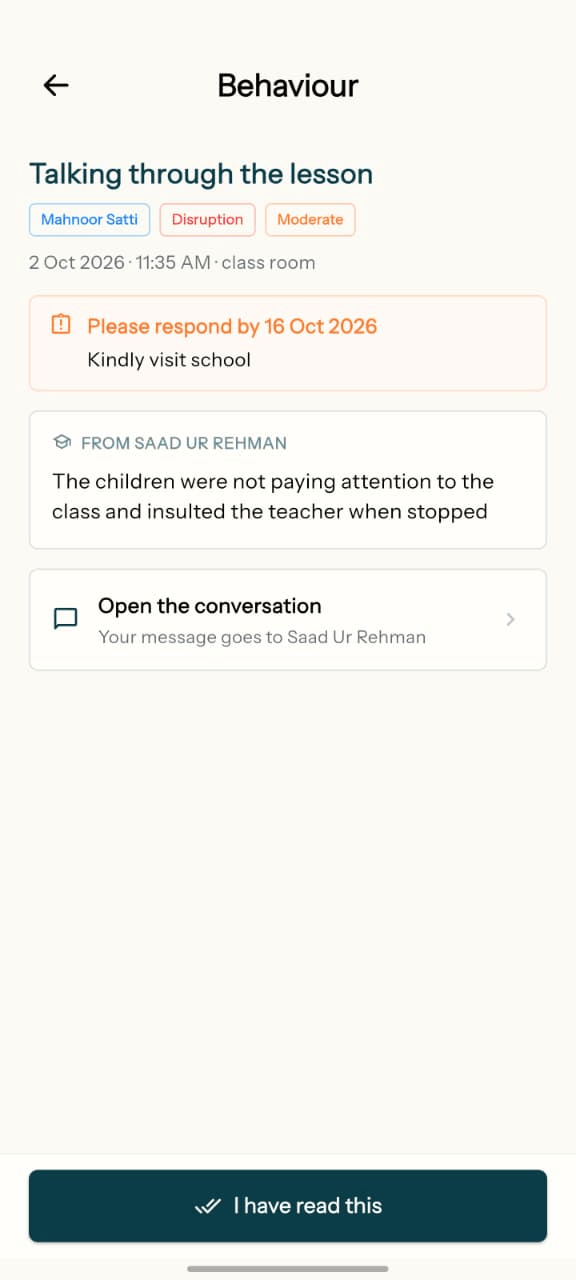
Edflo's behaviour module is built around this separation. Each entry has a staff record that never leaves the school and a message to parents written for the family, and when an entry covers a whole class, each family is told only about their own child. Parents read it in the Edflo app, acknowledge it and can reply, and the school can see who has read it. Any entry also prints as a notice for the family, one per child, carrying only the message to parents.
Key takeaways
- Keep the school's record and the letter to parents separate: one complete, one written for the family.
- Say what happened, what the school did, and what you want the parent to do, with a date if needed.
- Never name other children, and describe what the child did rather than what the child is.
- Send appreciation letters too, so a note from school is not always bad news.
- Ask parents to acknowledge the letter, so you know it arrived.
Frequently asked questions
How do you write a letter to parents about bad behaviour?
Keep it short and specific. Say what happened, when and where, in plain words; say what the school has already done; and say what you would like the parent to do next, with a date if you need them to come in. Leave out other children's names and labels such as rude or lazy, and describe what the child did rather than what the child is.
Should a behaviour letter name the other children involved?
No. Each family should hear only about their own child. If several children were involved, send each family its own letter. Naming other children breaches their privacy and usually turns the conversation into a dispute between families.
Should schools send letters home for good behaviour too?
Yes. A short appreciation note costs little, and it means parents do not learn to dread every message from school. It also makes the next concern easier to discuss, because the parent knows the school notices the good as well as the bad.
How do we know a parent has read a behaviour letter?
Ask for an acknowledgement: a signed slip returned to school, a reply, or an acknowledgement in the school's app. Without one, the school cannot tell a parent who chose not to respond from one who never received the letter.